 |
| Source: Wikipedia |
|
| C-1 Trader (TF-1 Grumman variant) (N6193Z)
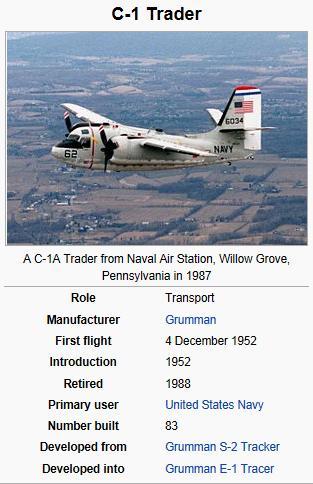
The Grumman C-1 Trader is a carrier onboard delivery (COD) variant of the Grumman S-2 Tracker. The TF-1 version includes an enlarged fuselage for 9 passengers, redesignated C-1A in 1962. There were 87 built.
The C-1 Trader grew out of a need by the United States Navy (USN) for a new anti submarine airplane. In response to this Grumman began development on a prototype twin-engine, high-wing aircraft which it designated the G-89. In 1952 the USN designated this aircraft the XS2F-1 and flew it for the first time on December 4 that year. During the rest of the 1950s three major variants emerged, the C-1 Trader being one of them. The C-1 (originally the TF-1) was outfitted to carry nine passengers or 3,500 pounds (1,600 kg) of cargo and first flew in January 1955.
|
Design and development
The C-1 Trader grew out of a need by the United States Navy (USN) for a new anti submarine airplane. In response to this Grumman began development on a prototype twin-engine, high-wing aircraft which it designated the G-89. In 1952 the USN designated this aircraft the XS2F-1 and flew it for the first time on December 4 that year. During the rest of the 1950s three major variants emerged, the C-1 Trader being one of them. The C-1 (originally the TF-1) was outfitted to carry nine passengers or 3,500 pounds (1,600 kg) of cargo and first flew in January 1955.
Operational history
Throughout the 1960s and 1970s the C-1 Trader carried mail and supplies to aircraft carriers on station in the Pacific Ocean during the Vietnam War and also served as a trainer for all-weather carrier operations. Over its production life 83 C-1 Traders were built, of which four were converted into EC-1A Tracer electronic countermeasures aircraft. The last C-1 was retired from USN service in 1988; approximately ten are still airworthy in civil hands, operated as warbirds.
In August 2010, Brazilian Naval Aviation announced that it will buy and modernize eight C-1 to served in the carrier onboard delivery (COD) and aerial refueling roles for use on its aircraft carrier São Paulo.
General characteristics
Crew: 2
Length: 42.2 ft (12.9 m)
Wingspan: 69.6 ft (21.2 m)
Height: 16.3 ft (4.9 m)
Empty weight: 18,750 lbs (8,504 kg)
Max. takeoff weight: 29,150 lbs (13,222 kg)
Powerplant: 2 × Wright R-1820-82WA Cyclone 9-cylinder radial piston engine, 1,525 hp (1,137 kW) each
Performance
Maximum speed: 287 mph (462 km/h)
Range: 1,300 miles (2,092 km)
|
|
